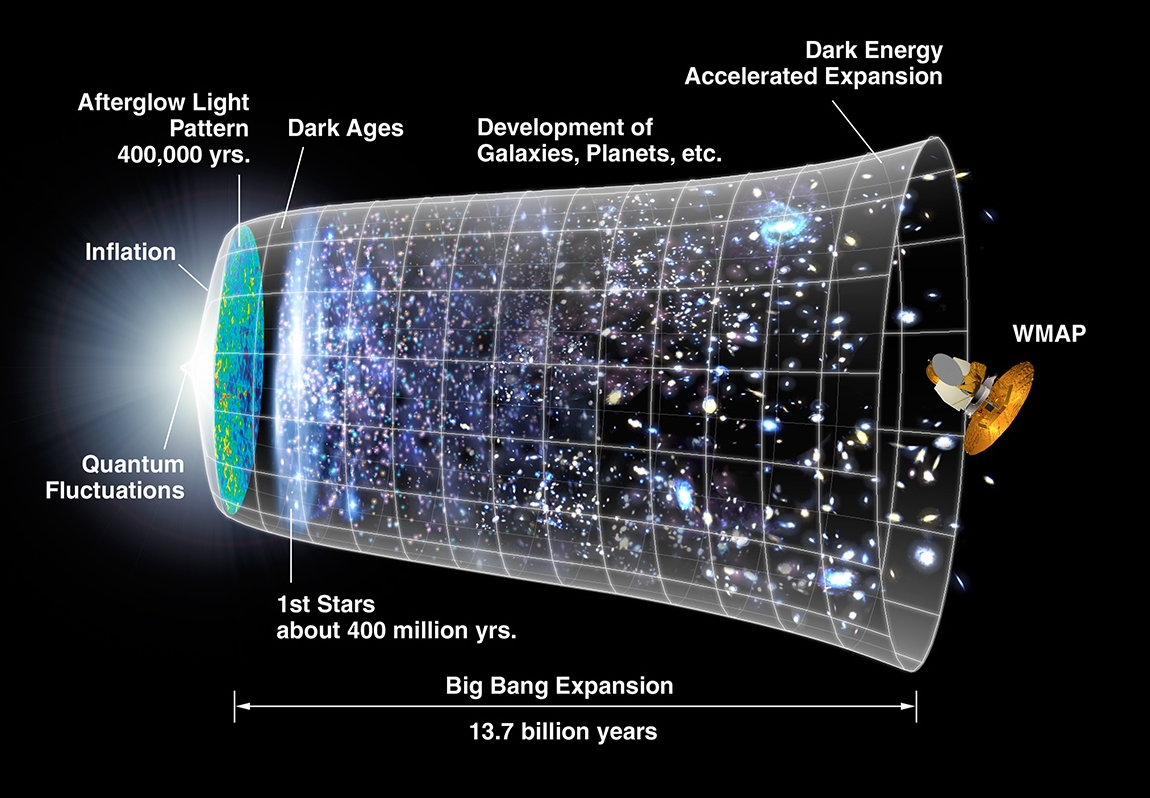
Figure 1: Brief History of the Universe Being Observed by the WMAP (http://lambda.gsfc.nasa.gov)
Figure 1: Brief History of the
Universe Being Observed by the WMAP (http://lambda.gsfc.nasa.gov)
The CMB radiation anisotropy is a
snapshot of the universe when it was only 380,000 years, and is a unique tool
for probing the early universe because it directly reflects the early matter
fluctuations of the universe. The WMAP observess the minute temperature
fluctuations at 23-94 GHz frequency range, with maximum angular resolution of
0.21 degree. The WMAP satellite has also observed the CMB polarization that is
much weaker (a few μK levels) than the temperature anisotropy. The CMB photons
were linearly polarized when they last-scattered with electrons at the
decoupling surface. Beause the polarization angle and intensity are tightly
related with radiation field surrounding the electrons, we expect that the
polarized signal is correlated with temperature fluctuations. In practice,
the observed temperature fluctuation is the sum of the CMB signal, instrument
noise, and contaminating signals from the Galactic and extragalactic sources.
For accurate measurement of statistical properties of CMB, subtracting the
foreground contribution is very important. For example, a foreground-reduced CMB
map is shown in Figure 2, where the map has been produced from the linear
combination of five WMAP maps at different frequencies by constraining the
variance of the combined map to be minimized.
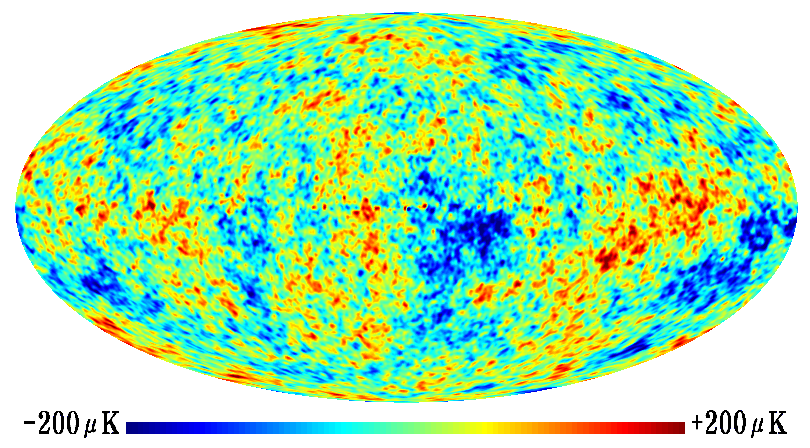
Figure 2: A
foreground-reduced CMB temperature anisotropy map (1.4 degree resolution)
produced by applying the internal linear combination method (Park, Park
& Gott 2007).
Cosmologists often use two-point statistics
(correlation function and power spectrum) as the primary tool for constraining
the cosmological model. If the field is Gaussian, the statistical property of
the field can be completely described by the two-point statistics. The power
spectrum is measured from the density field by applying the maximum likelihood
or Fourier transform methods. The fluctuations in the density field are
decomposed into waves with different wavelengths, and the power spectrum is
obtained as the amplitude variance of the waves at each wave number. For CMB
data, angular power spectrum Cl at each multipole l is measured from the
spherical harmonic expansion of the temperature fluctuations on the sphere. The
power spectra measured from the WMAP CMB temperature and polarizationi data are
shown in Figure 3, where power spectra of other CMB experiments are plotted for
comparison. Two model power spectra of the best-fit ΛCDM model and flat CDM
model with Λ=0 are also shown.
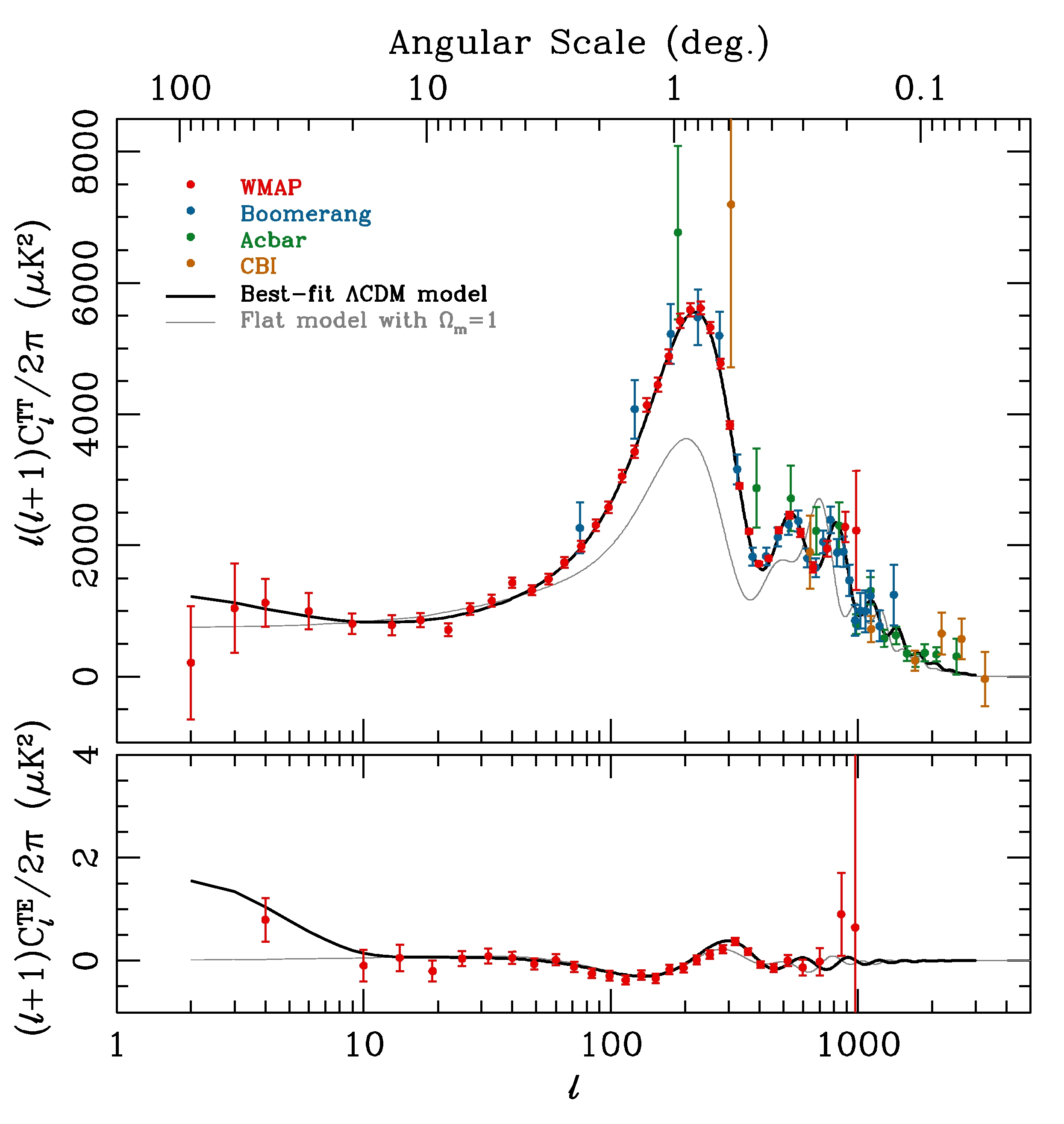
Figure 3: Angular power spectra
measured from CMB temperature and polarization data from WMAP, Acbar, Boomerang,
and CBI, denoted as ClTT for temperatures and ClTE for
temperature-polarization cross-correlation.
The appearance of the CMB
anisotropy power spectrum implies that our universe started from the adiabatic
initial conditions. The first acoustic peak is obviously seen in the temperature
(TT) power spectrum at l=220 (about 0.8 degree scale). The location of the first
acoustic peak corresponds to the sound horizon size at the decoupling epoch.
Inside the horizon, acoutic modes of photon-baryon fluid were oscillating with
compression and rarefaction, which induce a series of acoustic peaks and
troughs.
In the temperature-polarization (TE) cross-power spectrum,
non-zero correlation on both large (from reionization) and small (from adiabatic
fluctuations) angular scales have been detected . Especially, the former is the
signature of ionization of primordial hydrogen and helium due to the formation
of the first stars and galaxies. The detection of the reionization of the
universe corresponds to an optical depth τ = 0.088, and an epoch z=11 (or
t=400 Myrs after the Big Bang).
The WMAP team has derived cosmological
parameters from the temperature and polarization power spectra of the WMAP
3-year data. The CMB temperature and polarization data implies that the observed
CMB fluctuations are consistent with predictions of the concordance flat ΛCDM
model with adiabatic fluctuations which have been generated during the
inflationary epoch. The most important result is that the energy content of
the universe is 76% of dark energy and 24% of matter. The ordinary matter
(baryon) contributes only 4% to the total energy content. The luminous stars and
galaxies that we see today are only a small part of the total material in the
universe. The most material exists as dark matter. Furthermore, the present
universe is dominated by the dark energy, and is being accelerated.
The
KIAS cosmology group studies the statistical properties of the CMB anisotropy.
For this purpose, the group have been developing efficient algorithms to remove
the Galactic foreground emission in the observed CMB maps. Anothor research
subject is to quantify the level of non-Gaussianity from the observed CMB
temperature fluctuations. For example, the genus statstic can be measured from
the WMAP data to test for the Gaussianity of such primordial
fluctuations.
우주배경복사
우주론은 과학적 사고와 관측 자료 분석을 통하여 우주의 생성과 진화에 관한 의문점을 풀어가는 과학의 한 분야이다. 현대우주론은 아인슈타인(Einstein)이 1915년 일반상대성 이론을 확립하고, 1917년 균일 등방한 정적인 우주모형을 제안하면서 시작되었다. 1920년대에 들어와 프리드만(Friedmann)은 우주의 팽창과 수축을 포함하는 더욱 일반적인 우주 진화식을 유도해 내었고, 로버트슨(Robertson)과 워커(Walker)는 프리드만 우주모형의 이론적 토대를 보완하여 현재 프리드만-로버트슨-워커(FRW) 우주모형으로 불리는 균일 등방한 우주에 관한 물리적 모형을 완성하였다. 1929년 허블(Hubble)은 외부은하의 후퇴속도와 거리의 비례관계(허블의 법칙)로부터 우주의 팽창을 발견하였는데, 이보다 앞서 르메트르(Lemaitre)는 허블의 법칙을 이론적으로 유도하였을 뿐만 아니라 물질, 에너지가 한 점에 집중된 상태에서 우주가 생겨나 팽창해왔다는 내용의 대폭발 우주모형을 처음으로 생각해냈다. 허블의 우주팽창 발견은 대폭발 우주모형을 뒷받침하는 결정적인 증거로 생각되고 있다.
대폭발 모형과 우주배경복사는 무엇일까? 대부분의 과학자들은 우리우주가 약 137억 년 전 극도로 뜨거운 상태에서 대폭발과 급팽창을 겪으며 생겨났다고 생각하고 있다. 대폭발 우주모형에 따르면, 태초의 뜨거운 우주 속에는 빛, 전자, 양성자와 같은 수많은 기본 입자들이 서로 뒤섞여 충돌하며 열적평형상태를 유지하고 있었다. 열적평형상태의 빛은 플랑크의 흑체복사 스펙트럼을 갖는다고 알려져 있으며 흑체복사의 온도만 알면 특정 진동수에서 빛의 세기를 정확히 알아낼 수 있다. 이 흑체복사의 온도는 우주가 팽창함에 따라 내려가는데 이는 공기를 단열 팽창시키면 공기가 차가워지는 원리와 비슷하다. 우주의 나이가 38만년 정도 되었을 때, 팽창하며 식어가던 우주의 온도는 약 3000 K 정도로 내려갔고, 이온화돼 있던 수소와 헬륨 원자핵과 자유롭게 날아다니던 전자는 서로 달라붙게 돼 중성원자를 형성하였다. 빛과 숱하게 충돌하던 전자가 급격히 사라져버리자 빛은 물질과 더 이상 부딪치지 않고 자유롭게 우주공간을 퍼져 나가기 시작하였는데, 이 시기를 빛의 분리시기(decoupling era) 또는 재결합시기(recombination era)라고 한다. 이 빛은 흑체복사의 스펙트럼 성질을 그대로 간직한 채 아직까지도 우주를 떠돌아다니며 식어가고 있다. 우주 전체에 균일하게 퍼져 있는 이 빛을 우주배경복사(宇宙背景輻射, cosmic microwave background radiation)라고 한다. 우주배경복사는 현재 2.73 K인 차가운 흑체복사로 존재하며, 대폭발에 의한 우주 기원설을 뒷받침하는 직접적인 증거로 생각되고 있다 (그림 1).
우주거대구조, 은하단, 은하, 별, 태양계에 이르기까지 갖가지 규모의 우주 구조들은 모두 물질의 중력수축에 의하여 생겨났다. 만약 초기 우주의 물질분포가 균일하였다면 이들은 생성될 수 없으며, 중력수축에 의한 구조형성은 반드시 물질분포의 요동(fluctuation)이 존재해야만 가능하다. 과학자들은 우주거대구조의 씨앗이 존재하였을 것이라는 점과 우주배경복사가 빛의 분리시기 불균일한 물질분포에 대한 정보를 담고 있을 것이라는 점으로부터 우주배경복사의 온도는 하늘을 바라보는 방향에 따라 절대온도 2.73 K의 10만분의 1 정도 달라지는 미세한 온도 변화(수십 μK)를 지니고 있을 것으로 예측해 왔다. 이를 우주배경복사 온도의 비등방성(anisotropy)이라고 한다. 우주배경복사의 비등방성은 재결합 시기(t0=38만 년) 우주의 모습을 찍은 사진이자 우주 구조형성의 초기조건을 담고 있는 암호문이다. 코비의 뒤를 이어 발사된 WMAP은 우주배경복사의 온도요동을 23~94 GHz 주파수 영역에서 0.21° 고해상도로 더욱 정확히 관측하여 표준우주모형을 구성하는 우주론적 계수들(cosmological parameters)이 수 % 정밀도로 결정될 수 있도록 하는 등 우주론 연구에 획기적인 발전을 가져왔다. 그림 2은 WMAP 위성이 3년 동안 관측하여 얻어낸 자료에서 우리은하의 강한 방출선을 제거하여 나타낸 우주배경복사의 온도 요동지도이다.
\
구면 상의 복잡한 요동은 파장이 긴 것부터 짧은 것까지 다양한 파동으로 분류해 낼 수 있으며, WMAP이 관측한 배경복사의 온도요동도 파장이 90°~0.21°인 다양한 파동의 조합으로 기술할 수 있다. 그림 3은 WMAP의 3년 관측 자료로부터 측정한 우주배경복사 온도요동(위)과 온도-편광 상관성(아래) 파워스펙트럼이다(빨간색). 온도요동의 파워스펙트럼 그래프에는 코비 DMR 자료에서 얻은 파워스펙트럼(노란 다이아몬드)과 최근 Boomerang(파란색), Acbar(녹색), CBI(갈색) 실험에서 얻은 결과들이 함께 표시되어 있다. 굵고 검은 곡선은 암흑물질과 암흑에너지로 차있는 평탄한 우주모형의 이론적 예측을 나타낸다. 회색 곡선은 암흑물질로만 채워진 평탄한 우주모형의 예측으로서 WMAP의 관측 결과와 잘 맞지 않음을 보여준다. WMAP 우주배경복사 온도요동의 파워스펙트럼에서 한 가지 중요한 특징은 l=220 가까이에 첫째 봉우리가 위치한다는 것이다. 파워스펙트럼에서 첫째 봉우리의 위치는 우주의 기하학적 구조와 밀접한 관련이 있다. 우주가 평탄하면 l=220에, 닫혀 있으면 l<220에, 열려 있으면 l>220에 위치한다. 따라서 WMAP 파워스펙트럼의 첫째 봉우리 위치로부터 우리우주가 매우 평탄함을 알 수 있다. WMAP과 다른 고해상도 실험의 결과에 따르면, 우주배경복사의 온도요동은 약 1° 규모에서 파워가 가장 세며 작은 규모로 갈수록 파워가 증감을 거듭하면서 낮아진다. WMAP은 1° 이하 규모에서 나타나는 우주배경복사 온도요동과 편광이 우주 초기에 존재한 단열적(adiabatic) 요동의 음파진동으로부터 생겨났다는 것을 정확히 밝혀냈으며, 이는 급팽창 우주모형을 지지하는 결정적인 증거로 생각되고 있다.
현대우주론의 주요 목표는 천문관측 자료와 가장 잘 맞는 우주모형을 만들고 그 우주모형을 규정짓는 우주론적 계수들을 정확하게 측정하는 것이다. 물질과 에너지 분포에 섭동을 가해 얻은 표준 FRW 우주모형에서 빛의 분포함수를 시간에 따라 진화시키면 특정 우주모형에서 예측되는 우주배경복사 온도요동과 편광의 파워스펙트럼을 이론적으로 구해낼 수 있다. 과학자들은 관측 자료에서 구한 파워스펙트럼을 표준우주모형에서 예측한 이론적인 파워스펙트럼(그림 3의 굵은 선)과 비교하여, 관측 자료를 가장 잘 맞추는 우주론적 계수들을 찾아낸다. WMAP 팀은, 우리우주가 공간적으로 평탄하며 나이는 137억 년이라는 것, 전체 에너지 중 바리온(보통물질)이 차지하는 비율은 겨우 4% 정도이고, 암흑에너지와 차가운 암흑물질(cold dark matter; CDM)이 각각 76%와 20%나 차지하고 있는 것을 밝혀내었다. 암흑에너지는 아인슈타인이 정적 우주모형에 도입하였던 우주상수 Λ로 보통 표현되며, 중력의 반대 성질을 지니고 있어 현재 우리우주의 가속팽창에 대한 원인으로 생각되고 있다. 우리우주를 가장 가깝게 기술하는 이 FRW 모형을 평탄한 ΛCDM 우주모형이라고 부른다.
고등과학원의 우주론 그룹은 우주배경복사 비등방성의 통계적 특성을 연구하고 있다. 이를 위해, 관측으로 얻어낸 배경복사 자료에서 우리은하의 강한 방출선에 의한 오염을 줄이는 효율적인 알고리즘을 개발하고 있다. 또한, 우주배경복사 온도요동 자료를 사용하여 우주 원시 요동의 정규성(Gaussianity)을 검정하는 연구도 수행 중이다.